
A SEED TO SPOON AGRITOURISM TRAIL IN GHANA'S VOLTA REGION

Honey

Hodzo Honey Tour
Honey production in Ghana is a growing, largely artisanal, and sustainable agricultural sector, heavily supported by initiatives aimed at enhancing rural livelihoods and biodiversity conservation.
Bees primarily eat nectar and pollen, relying on stored honey only when fresh food is scarce
Nectar is perishable, but through enzymatic activity and dehydration, bees turn it into honey, which has natural antibacterial properties and can be stored indefinitely
honey is the bees primary, high-energy food source, for bees. They produce and store honey to act as a crucial food reserve when nectar is scarce, providing essential carbohydrates to fuel the colony, maintain hive temperature, and support foraging activities. Bees also collect and eat pollen for protein.
offering high-quality, 100% raw, and wild, unadulterated options
Quote:
“ We can only produce pure honey by keeping healthy bees. For that, we need to protect the environment. We have to find more responsible and holistic approaches to farming and forestry, so we create more healthy habitats for bees. ”
about protecting the environment and creating awareness about the dangers of deforestation.
What Will You Experience?
_JPEG.jpeg)
Volta region recognized across Ghana as being an ideal location for honey production.
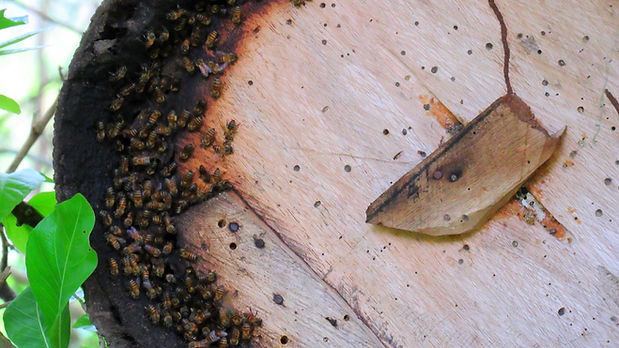
In Hodzo-Achianse, the honey industry thrives on natural nectar sources where bees collect nectar from blooming citrus grove and forest tree flowers. Here, the bees make a rich and delicious forest honey by collecting nectar from flowers, breaking it down with enzymes, and evaporating the water content in their hives.
Beekeepers crop honeycomb twice a year, at the very beginning and end of the dry season
In the Volta Region, groundnut cultivation is driven by smallholder farmers who primarily use rain-fed systems with limited improved inputs. Local production of groundnuts is primarily for local consumption, and provides significant economic livelihoods through local, small-scale production. Groundnuts are both a major source of protein in the Ghanaian diet and a key cash crop. They are an important local subsistence crop and as well as key commercial income source.
This tour will cover the groundnut production cycle by visiting a peanut farm in Adaklu-Waya to learn about the groundnut growing cycle.
-
Learn about cultivation, harvesting, drying, and storage.
-
Experience the the process of shelling, as well as small-scale processing
Because of the seasonal nature of agriculture, some aspects of planting, harvesting, and production will be out of season; however, travelers may engage with growers and producers who are prepared to share their insider knowledge.


